


What are Aggregates?
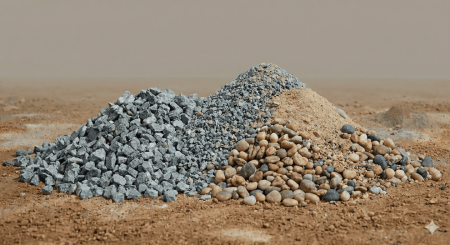
Aggregates are granular construction materials such as sand, gravel, crushed stone, and recycled concrete. They provide bulk, strength, stability, and durability to concrete, mortar, asphalt, and road layers. High-quality aggregates improve structural performance, reduce shrinkage, and increase the lifespan of any construction project.
♦ What are the Types of Aggregates?
- Fine Aggregate: Particles smaller than 4.75 mm (sand or crushed dust). They fill voids in concrete and enhance workability and finish.
- Coarse Aggregate: Particles larger than 4.75 mm such as gravel and crushed stone (10mm, 20mm, 40mm). They form the structural skeleton of concrete and increase its strength.
♦ What is the Role of Aggregates in Concrete?
Aggregates are the most important component in concrete after cement. They provide bulk volume, compressive strength, dimensional stability, and reduce material cost, making concrete more durable and economical.
♦ How Does Aggregate Size Affect Concrete?
- Larger Aggregates: Increase compressive strength and reduce cement consumption.
- Smaller Aggregates: Improve finishing quality and workability for plaster and masonry.
♦ Types of Aggregates by Source
- Natural Aggregates: Sand, gravel, crushed stone sourced from quarries, riverbeds, and natural deposits.
- Recycled Aggregates: Produced from crushed concrete, demolished structures, bricks, and reclaimed asphalt.
- Manufactured Aggregates: Include M-Sand, steel slag, expanded clay, and industrial by-products designed to meet construction standards.
♦ Does the Shape of Aggregates Matter?
- Angular Aggregates: Provide superior interlocking, higher strength, and better bonding in concrete.
- Rounded Aggregates: Improve workability but offer slightly lower bonding strength.
♦ Can Recycled Aggregates Be Used in Load-Bearing Structures?
Recycled Aggregates are suitable for road base layers, sub-base, and non-structural concrete. For structural or load-bearing applications, engineering approval and adherence to construction standards are required.
♦ How is Aggregate Quality Tested?
Aggregate quality is tested by examining particle size (gradation), shape, hardness, durability, absorption, density, and cleanliness. Tests also check for clay, organic matter, and impurities to ensure structural reliability.
♦ What is the Ideal Aggregate-to-Cement Ratio?
- A standard concrete mix ratio is 1:2:4 (Cement : Sand : Aggregate), depending on strength requirements and project specifications.
♦ How is Aggregate Produced?
Aggregates are produced by extracting materials from quarries or riverbeds, followed by crushing, screening, washing, and grading. Manufactured Aggregates are produced using industrial processes or recycled construction materials.
♦ How are Hardness and Toughness Measured?
Aggregate hardness and toughness are measured through tests such as abrasion resistance, soundness test, impact value test, density test, and durability tests to evaluate their performance in concrete and road applications.