Quote Cart

0 items · Prices shared after review

Your cart is empty

Pick a brand and unit, then tap Add to Cart.

Final price depends on your quotation.

ConstroMat
C
ConstroMat Desk@constromat

Understanding Invoice Discounting

INVOICE DISCOUNTING This is a financing practice followed by businesses to help manage their short-term working capital requirements. When companies sell products and services, they issue invoices to customers. If there is a delay in payment by customers, companies use these unpaid invoices to raise funds from lending institutions. The borrowed amount is a percentage of the invoice value and lending institutions charge an interest and fee for providing this service. When customers make the due p

Understanding Invoice Discounting

INVOICE DISCOUNTING This is a financing practice followed by businesses to help manage their short-term working capital requirements. When companies sell products and services, they issue invoices to customers. If there is a delay in payment by customers, companies use these unpaid invoices to raise funds from lending institutions. The borrowed amount is a percentage of the invoice value and lending institutions charge an interest and fee for providing this service. When customers make the due payment, the company returns the amount to the lender with interest. TYPES OF INVOICE DISCOUNTING Confidential: In this case, the company keeps the entire exercise of invoice discounting confidential, without disclosing it to customers. It raises funds from the lender and settles the amount after its customers make the payment, without the latter being aware of the entire process. Disclosed: As the term suggests, here the customers are aware of the company’s arrangement with the lending institution for raising funds by using the invoices. Whole turnover: This is when a company uses almost its entire sales ledger or a large volume of its invoices to raise funds from a lender. Selective: As opposed to the whole turnover, selective invoice discounting involves picking a section of the sales ledger for raising funds. The invoices can be selected on the basis of their value, payment terms, etc. BENEFITS Cash flow: The company can generate funds instantly through invoice discounting instead of waiting for customer payments, which can follow a 30-90-day cycle. No collateral: The business doesn’t need to keep property or equipment as collateral with the financial institution to raise funds. Easier than loan: It’s a simple, uncomplicated process to generate cash, where the amount is disbursed much faster than in case of a business loan.

11 August 2026
0 Likes

More from the feed

S
Saurabh Shankar·24 Jul 2026

Trend Watch: AI in Pre-construction—Empowerment, Not Replacement

Artificial intelligence is dominating in construction estimating. As AI-powered tools for takeoffs and drawing analysis become industry standard, the inevitable question arises: Will AI replace human estimators? The short answer is no. Instead, we are seeing a massive shift in how estimators deliver value. AI is proving highly effective at automating repetitive, time-intensive tasks like quantity takeoffs and drawing comparisons.By offloading the busywork, estimators are freed up to do what mac

Trend Watch: AI in Pre-construction—Empowerment, Not Replacement
C
ConstroMat Desk·14 Jul 2026

Industry Update : Cement Industry

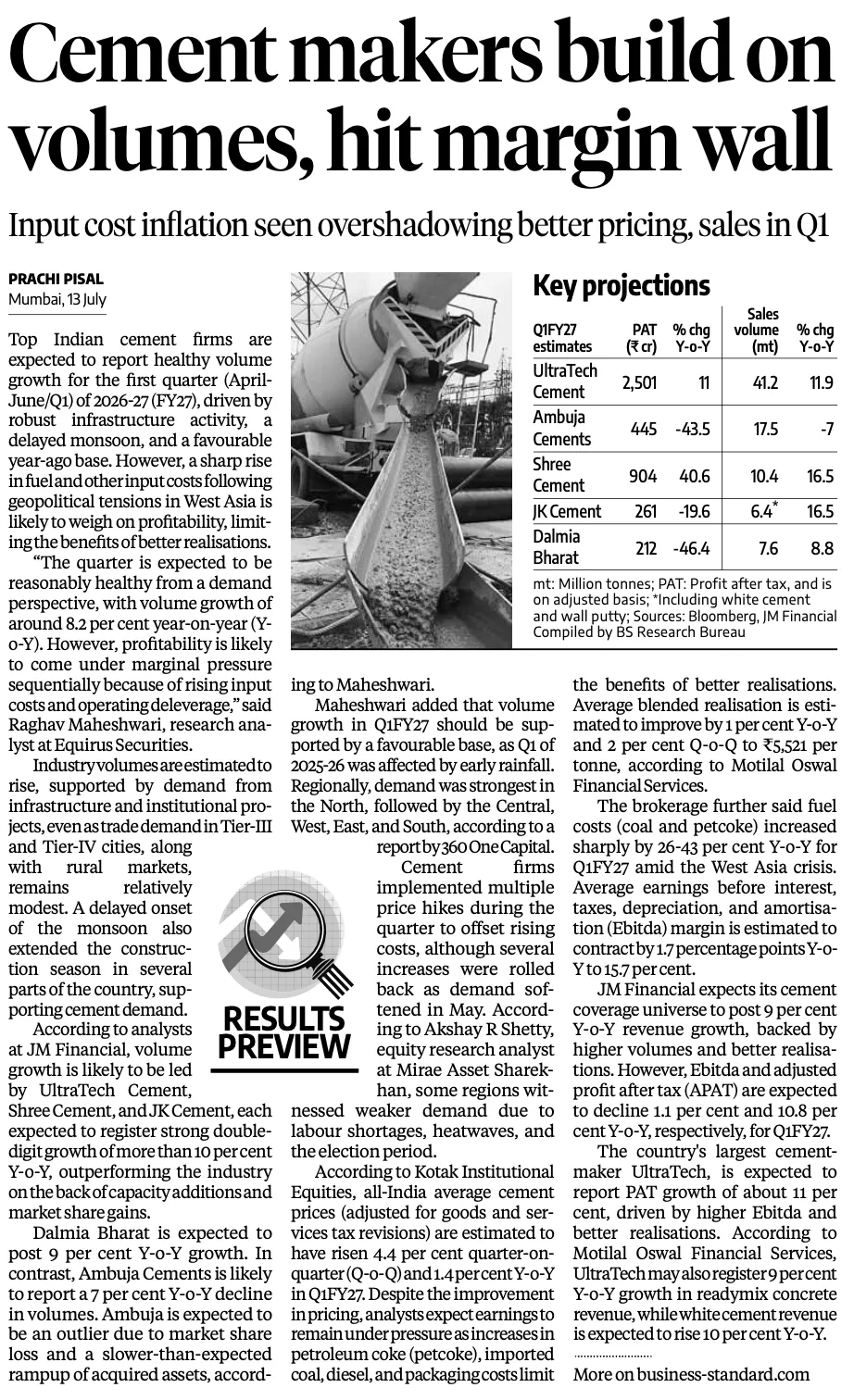
Top Indian cement firms are expected to report healthy volume growth for the first quarter (April-June/Q1) of 2026-27 (FY27), driven by robust infrastructure activity, a delayed monsoon, and a favourable year-ago base. The quarter is expected to be reasonably healthy from a demand perspective, with

Industry Update : Cement Industry
C
Constromat Desk·25 Jun 2026

Understanding Cement Trade in India

Understanding Cement Trade in India Cement sales in India are split into two categories: 1. Non-trade: Sold in bulk directly to the government or large institutions. This is a "volume game" with lower margins due to high-quantity discounts. 2. Trade: Sold to smaller buyers (like individual retai

Understanding Cement Trade in India
C
ConstroMat Desk·19 Jun 2026

India Construction Market size

The India Construction Market size is projected to be USD 0.74 trillion in 2025, USD 0.79 trillion in 2026, and reach USD 1.10 trillion by 2031, growing at a CAGR of 6.87% from 2026 to 2031. Accelerated highway contract awards, renewable-energy build-outs, and rapid data-center expansion continue to

India Construction Market size

Explore on ConstroMat

HSN Code Finder

Look up HSN codes & GST rates instantly

ConstroQuant Estimator

Estimate material quantities for your project

Industry Primer

Learn how cement, steel & more are made

Our Blogs

Insights & updates from the construction industry

Chat on WhatsApp

Talk to our team directly