
Every TMT bar in your slab started as a piece of rock buried in the ground. Here is the simple story of how that rock becomes the steel you build with — explained in six clear steps.
Steel is the backbone of almost everything we build, from a small house to a flyover. Yet most people who buy steel never see how it is made. The journey is long, but it is not complicated once you break it down. At its heart, steelmaking does one thing: it takes iron ore out of the earth and slowly turns it into strong, reliable steel. This guide walks you through all six steps, in plain language, and shows where the TMT bar you order from ConstroMat fits into the chain.
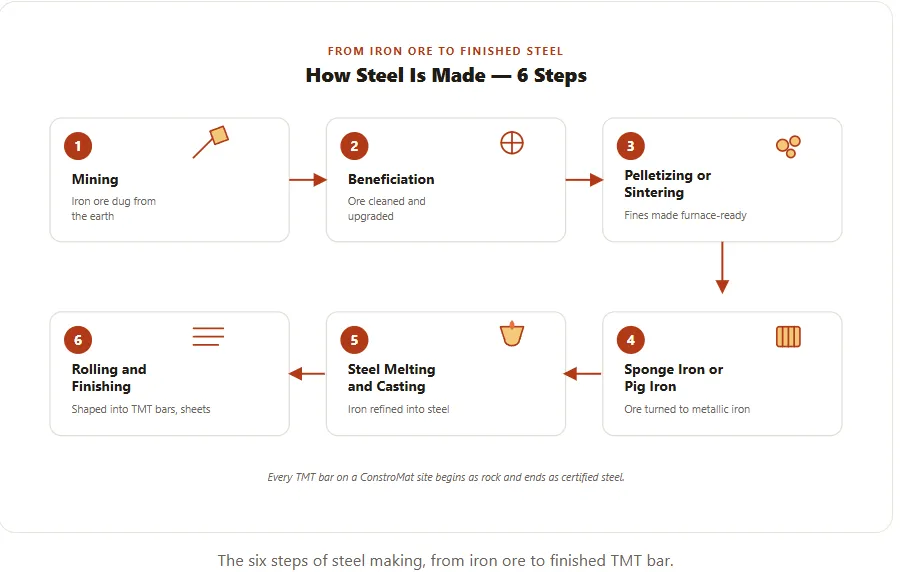
Mining, Beneficiation, Pelletizing or Sintering, Sponge Iron or Pig Iron, Steel Melting and Casting, then Rolling and Finishing. FROM IRON ORE TO FINISHED STEEL How Steel Is Made — 6 Steps 1 Mining Iron ore dug fromthe earth 2 Beneficiation Ore cleaned andupgraded 3 Pelletizing orSintering Fines made furnace-ready 6 Rolling andFinishing Shaped into TMT bars, sheets 5 Steel Meltingand Casting Iron refined into steel 4 Sponge Iron orPig Iron Ore turned to metallic iron Every TMT bar on a ConstroMat site begins as rock and ends as certified steel.
The six steps of steel making, from iron ore to finished TMT bar.
STEP 1
Mining: Pulling Iron Out of the Ground
Everything begins in a mine. Iron ore is a reddish or dark rock that holds iron inside it. Large machines drill, blast and scoop this rock out of open pits or underground mines. The ore is then crushed into smaller pieces so it is easier to carry to the plant.
Not all ore is equal. Its quality is measured by how much iron it holds, shown as Fe%. High-grade ore can be 60% iron or more and needs very little extra work. Lower-grade ore has more waste rock mixed in and needs more cleaning later. India is rich in iron ore, with big reserves in Odisha, Chhattisgarh, Jharkhand and Karnataka. Some companies, like NMDC and OMC, only mine ore and sell it. Others, like Tata Steel, SAIL and JSW, own their mines and feed the ore straight into their own steel plants.
STEP 2
Beneficiation: Cleaning and Upgrading the Ore
Raw ore is rarely pure enough to use right away. Beneficiation is the step that cleans it. The ore is crushed, ground and washed, and then passed through magnets or water-based methods that separate the iron-rich part from the dirt and waste minerals.
The goal is simple: raise the iron content and lower impurities like silica and alumina. Better ore going in means a more efficient furnace, less fuel burned and better steel coming out. If the ore is already very high grade, this step can be short. But for much of India's medium-grade ore, beneficiation is what makes it worth using.
STEP 3
Pelletizing or Sintering: Making the Ore Furnace-Ready
After cleaning, the ore is often left as a fine powder. You cannot pour powder straight into a furnace — it would block the airflow. So the fine ore is bound back together into larger, usable pieces. There are two common ways to do this.
Pelletizing mixes the fine ore with a little water and a binder, then rolls it into small balls. These balls are heated until they harden into strong, uniform pellets. Sintering mixes the fine ore with coke and limestone, then heats it into a solid mass that is broken into chunks called sinter. Pellets are higher quality and very efficient; sinter is cheaper and widely used in large furnaces. Both do the same important job — they make sure no fine ore goes to waste.
STEP 4
Sponge Iron or Pig Iron: Turning Ore Into Metal
Now the ore becomes actual metallic iron — though it is still not steel yet. There are two routes, and India uses both.
Sponge iron, also called Direct Reduced Iron (DRI), is made by heating ore with coal or gas without melting it. The oxygen is stripped out of the ore, leaving behind solid, porous iron. India is the largest producer of sponge iron in the world, thanks to plenty of ore and coal. Pig iron is made the older way: ore, coke and limestone are melted together in a towering blast furnace at around 1,500°C, producing molten iron. Sponge iron is flexible and suits smaller plants; pig iron works best at very large scale.
Sponge iron vs pig iron, in one line:
Sponge iron is solid iron made without melting. Pig iron is molten iron made by melting. Both are simply the raw iron that the next step turns into steel.
STEP 5
Steel Melting and Casting: Iron Becomes Steel
This is the step where iron finally becomes steel. The difference between iron and steel is mostly carbon. Raw iron holds too much carbon, which makes it brittle. Steelmaking removes most of that carbon and controls the impurities so the metal turns strong and flexible.
There are two main methods. A Basic Oxygen Furnace (BOF) blows pure oxygen through molten pig iron to burn off the extra carbon — fast and ideal for very large plants. An Electric Arc Furnace or Induction Furnace uses electricity to melt sponge iron and scrap, which is common across India's smaller mills and great for recycling. Once the steel is ready, it is poured into a continuous casting machine and solidified into semi-finished shapes called billets, blooms and slabs. These are the building blocks for the final step.
STEP 6
Rolling and Finishing: The Steel You Actually Buy
The semi-finished steel is reheated until it is soft and red hot, then squeezed through heavy rollers that shape it into finished products. This is the step that creates the steel you recognise on site.
Long products — like TMT bars, wire rods and beams — are rolled from billets and used heavily in construction. Flat products — like sheets and coils — are rolled from slabs and used for car bodies, appliances and roofing. A TMT bar gets one extra trick: right after rolling, it is rapidly cooled on the surface. This gives it a hard outer layer and a softer, flexible core — exactly the combination that makes it strong yet bendable for concrete work. Many plants add further value with galvanizing, pipes or coatings.
This is where ConstroMat picks up the story
By Step 6, steel is ready to build with — and that is the moment it reaches you. ConstroMat connects builders, contractors and homeowners across East India with trusted TMT bar brands and other construction materials, delivered with clear pricing and quality you can rely on. You handle the building; we will handle the steel.
Browse TMT Bars on ConstroMat →
The 6 Steps at a Glance
Step | What happens | Output |
|---|---|---|
1. Mining | Iron ore is dug out and crushed | Crushed iron ore |
2. Beneficiation | Ore is cleaned and upgraded | High-grade ore concentrate |
3. Pelletizing / Sintering | Fine ore is bound into usable pieces | Pellets or sinter |
4. Sponge / Pig Iron | Ore is converted into metallic iron | Sponge iron or pig iron |
5. Melting & Casting | Iron is refined into steel and cast | Billets, blooms, slabs |
6. Rolling & Finishing | Steel is shaped into final products | TMT bars, sheets, pipes |
Why This Matters When You Buy Steel
Knowing the journey helps you buy smarter. A TMT bar is not just metal — it is the result of six careful steps, and quality at each stage shows up in the final product. That is why the brand and the source of your steel matter. Buying from a trusted supplier means the steel reaching your site has been through the right process and meets the standards your structure depends on.
Frequently Asked Questions
What is steel made from?
Steel is made from iron ore. The ore is first turned into iron, and then most of the carbon and impurities are removed to make steel.
What is the difference between sponge iron and pig iron?
Sponge iron is solid iron made by removing oxygen from ore without melting it. Pig iron is molten iron made by melting ore in a blast furnace. Both are then refined into steel.
How is a TMT bar made?
A TMT bar is rolled from a semi-finished steel billet and then rapidly cooled on the surface. This gives it a hard outer layer and a soft, flexible core — strong enough to carry load, bendable enough to work with.
Need steel for your next project?
Get TMT bars and construction materials from trusted brands, with transparent pricing and reliable delivery across Jharkhand, Bihar and beyond.
Written by
Saurabh Shankar
Expert contributor at ConstroMat, sharing insights on construction materials, industry trends, and best practices.
View all posts