
Why Does the Right Sand Matter So Much?
Sand is everywhere on a construction site — in concrete, in mortar, in plaster, under floors. It is also one of the most commonly mis-purchased materials. Builders order whatever is cheapest, or whatever is available, without checking if it is actually right for the job. The result? Weak walls. Cracked plaster. Corroded steel. And extra costs to fix all of it.
The good news: choosing the right sand is not complicated. You just need to know what each type is good for — and what it costs. That's exactly what this guide covers.
Quick Tip: Always ask your supplier for extraction or royalty certificates. ConstroMat verifies these from every supplier so you don't have to worry about illegal or substandard sand reaching your site.
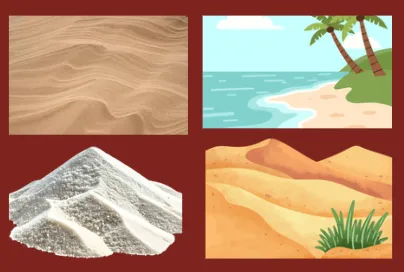
The 6 Types of Construction Sand — Explained Simply
🏞️ 1. River Sand (Natural Sand) ₹2,200–₹3,200/tonne
River sand comes from river beds. Water shapes the grains over years, making them smooth and rounded. This is what most people think of when they say "sand for construction."
Best for: Plastering walls, brick masonry, flooring base, and finishing work where a smooth texture matters.
Buyer's note: River sand is high quality but increasingly hard to get due to government mining restrictions in many states. Prices can spike during peak season. If availability is a concern in your area, M-Sand is your best backup.
🏗️ 2. M-Sand (Manufactured Sand) ₹1,400–₹2,200/tonne
M-Sand is made by crushing hard rocks — usually granite or basalt — into sand-sized particles. It is made in factories, so quality is consistent and predictable every time you order.
Best for: RCC structures (beams, columns, slabs), roads, highways, flyovers, concrete blocks, and any large-scale structural work.
There are 3 types of M-Sand:
Concrete M-Sand — for RCC and structural work
Plaster M-Sand — finer grade, for wall finishing
Brickwork M-Sand — for block and masonry applications
Buyer's note: M-Sand is the most widely available and most affordable sand in India right now. It is 15–30% cheaper than river sand and ticks every sustainability box. For large projects, this is almost always the smart choice.
🪨 3. Pit Sand (Coarse Sand) Price varies by region
Pit sand is dug from the ground, away from rivers. It is coarser and more angular than river sand, which means cement grips it better.
Best for: Foundations, heavy structural work, roads, and any application where raw strength matters more than smooth finish.
Buyer's note: Pit sand is excellent for foundations but not for plastering — the rough texture will show on finished walls. Check local availability because transport cost can make it expensive depending on your city.
🌊 4. Sea Sand Low raw cost, high treatment cost
Sea sand is found along the coast. It looks fine and clean, but it contains salt — and salt is the enemy of steel reinforcement.
Best for: Land-filling and levelling only. Do NOT use for structural work.
Buyer's note: Avoid sea sand for any structural or finishing application. The salt corrodes rebar, reduces concrete durability, and can cause long-term structural failure. Even when washed, residual chlorides are a risk.
🏜️ 5. Desert Sand Rarely used
Desert sand (found mainly in Rajasthan) is very fine and extremely smooth. It looks abundant and cheap, but it doesn't stick to cement.
Best for: Almost nothing in standard construction. Its smooth, round grains cannot form strong bonds in concrete or mortar.
Buyer's note: You will almost never need to buy desert sand. If someone offers it cheap, save yourself the rework cost and pass.
💎 6. Silica Sand High — specialty material
Silica sand has very high silicon content. It is white, chemically stable, and extremely hard. This is an industrial-grade material.
Best for: Glass manufacturing, ceramics, water filtration, decorative concrete, and specialty flooring.
Buyer's note: Unless you are doing specialty finishing or industrial work, you won't need silica sand. It's not a regular construction purchase.
Quick Comparison: All Sand Types at a Glance
Sand Type | Best Use | Strength | Cost | Availability |
|---|---|---|---|---|
River Sand | Plastering, masonry | Medium–High | High | Limited |
M-Sand | RCC, infrastructure | High | Medium | High ✅ |
Pit Sand | Foundations, heavy structures | Very High | Medium–High | Regional |
Sea Sand | Landfilling only | Low ⚠️ | Low | Coastal |
Desert Sand | Not recommended | Low ⚠️ | Low | Limited |
Silica Sand | Industrial / specialty | High | High | Controlled |
How to Decide Which Sand to Buy
Ask yourself three questions before placing any order:
What is the sand for?
Plastering and finishing → River Sand or Plaster M-Sand.
Concrete columns, beams, slabs → Concrete M-Sand or Pit Sand.
Foundation work → Pit Sand or coarse M-Sand.What is your budget?
If cost is a concern, M-Sand is almost always the right call. It is cheaper than river sand, consistently available, and performs just as well for structural work.Is the supplier giving you proper certificates?
Sand sourcing is regulated across India. Any supplier who cannot show extraction or royalty certificates is a legal — and quality — risk. Always verify.
Watch out for this common mistake: Many buyers mix up Plaster Sand and Concrete Sand, or order M-Sand without specifying the type. Always mention the application when you place your order. One phone call to your supplier can save you an entire redoing of your wall plaster.
What Makes Sand Prices Go Up or Down?
Sand prices in India are not fixed — they move based on several factors:
Type and quality — River sand commands a premium; M-Sand is more stable in price.
Mining and environmental rules — State restrictions on river mining directly impact availability and cost of river sand.
Transportation distance — Sand is heavy. Longer haul = higher price. Local suppliers are almost always cheaper.
Season — Construction peaks in winter months (Oct–Feb), which drives up demand and prices.
Government permits — Regional availability of permits affects which types of sand can be legally sourced in your area.
Ready to Order Sand? ConstroMat Has You Covered.
Browse verified suppliers for River Sand, M-Sand, Pit Sand and more — all with royalty certificates, transparent pricing, and delivery across Jharkhand and Bihar. No guesswork. No middlemen.
The Bottom Line
Sand is not just "dirt on a truck." The wrong type in the wrong place costs you time, money, and structural safety. The right type — sourced from verified suppliers — is the foundation (literally) of a building that lasts.
In 2026, for most construction buyers in India, M-Sand is the go-to choice for structural work — predictable quality, good availability, and lower cost. For finishing and plastering, River Sand or Plaster-grade M-Sand both do the job well. For foundations where you need brute strength, Pit Sand delivers.
And wherever you buy from — make sure your supplier can show you their extraction certificate. That one document tells you the sand is legal, traceable, and safe to use on your site.
Tags: Sand M-Sand River Sand Construction Materials Buying Guide Construction India 2026 Aggregates
© 2026 ConstroMat — Indithrive Infratech Pvt Ltd. · Click. Select. Build.
Written by
Saurabh Shankar
Expert contributor at ConstroMat, sharing insights on construction materials, industry trends, and best practices.
View all posts