
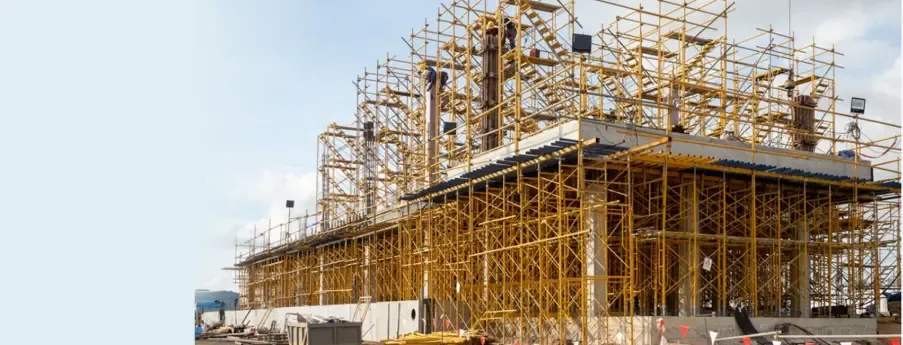
Do you have the right scaffolding system, for every job, at every stage of your project?
Every year in India, falls from height account for one of the leading causes of fatalities on construction sites. In most cases, the root cause is not bad luck — it is the wrong scaffolding, poorly erected, on a site where no one checked compliance. With India's construction sector expanding faster than ever — metro rail, elevated highways & bridges, high-rises, industrial plants — the stakes of getting your work-at-height setup wrong have never been higher.
This guide covers everything a contractor, site engineer, or procurement manager needs to know — from the types of scaffolding used across Indian construction segments, to the IS codes and BOCW Act provisions you are legally required to follow, to the practical challenges you will face on Indian sites and how to address them.
What Scaffolding Actually Does — and Why It Matters More Than You Think
Scaffolding is a temporary elevated work platform that supports workers, materials, and equipment during construction, maintenance, or repair.
In India's construction context, scaffolding needs to do more than hold weight. It needs to be quickly erected and dismantled as work progresses, adaptable to irregular geometries and tight urban sites, and robust enough to withstand monsoon winds, seismic loads, and the varied ground conditions found across Indian project sites.
The right system — is not a cost. It is what keeps your project moving.
Where Scaffolding Is Used Across Indian Construction
Scaffolding requirements vary significantly depending on the type of project. Here is how it maps across the major segments of Indian construction:
Residential and Commercial Buildings
In urban residential and commercial projects, scaffolding is used throughout the superstructure phase — for brickwork, plastering, façade installation, painting, and cladding.
Infrastructure: Metro, Bridges, and Elevated Highways
Metro rail systems, flyovers, bridges, and elevated highway corridors require heavy-duty scaffolding capable of carrying significant dynamic loads.
Industrial Construction
Power plants, chemical plants, refineries, and steel manufacturing facilities require specialised scaffolding for installation, maintenance shutdowns, and turnarounds.
Heritage Conservation and Renovation
The Archaeological Survey of India (ASI) and state conservation bodies supervise scaffolding at heritage monument restoration sites.
Types of Scaffolding: Choosing the Right System for Your Site
Understanding the available types is the first step to procurement — and the wrong choice wastes money and time even if it does not cause an accident.
Supported scaffolding is the most common type in India, built upward from the ground using steel tubes and couplers or pre-engineered frames. It suits multi-storey residential and commercial projects where the full height is being worked simultaneously.
Suspended scaffolding hangs from the roof or a higher structural point using ropes or chains. It is used for external façade work, window cleaning, and painting on tall buildings where ground support is impractical. Correct load-rated suspension equipment and regular inspection of anchor points are non-negotiable.
Rolling (mobile) scaffolding is mounted on wheels and designed to be repositioned frequently — useful for interior finishing work, ceiling work, or maintenance tasks where the work area shifts regularly. Wheels must be locked whenever workers are on the platform.
Cantilever scaffolding is used when the ground below cannot support a scaffold base — due to traffic, adjacent structures, or unstable soil. It projects outward from the building structure and requires careful structural design and approval.
System (modular) scaffolding — including cup-lock, ring-lock, and frame systems — uses pre-engineered components that lock together without loose couplers. Modern bolt-free auto-lock systems now allow automatically right-angled, obtuse-angled, or acute-angled configurations, with built-in safety locks. These systems offer faster erection times, more predictable load performance, and better compliance with IS standards than traditional tube-and-coupler setups. For mid-to-large projects, the time and safety advantages typically outweigh the slightly higher procurement cost.
ConstroMat tip: If you are sourcing scaffolding systems for a project in Eastern India, our supplier network includes verified vendors. You can place an RFQ for multiple scaffold types simultaneously and compare pricing, availability, and logistics from a single platform — app.constromat.com.
Indian Safety Standards and Legal Compliance: What You Must Know
IS 2750 and IS 4014: The Core Technical Standards
The Bureau of Indian Standards has two primary codes governing scaffolding:
IS 2750 (Steel Scaffoldings) — covers material specifications, load requirements, and design for steel scaffolding components
IS 4014 (Code of Practice for Steel Tubular Scaffolding) — Part 1 covers materials and construction, Part 2 covers safety requirements and working rules
The BOCW Act, 1996 — Your Legal Obligation
The Building and Other Construction Workers (Regulation of Employment and Conditions of Service) Act, 1996, and its associated BOCW (RE&CS) Rules, 1998 place direct legal obligations on every establishment employing 10 or more construction workers.
All scaffolding must be erected, altered, or dismantled only under the supervision of a competent person
Scaffold platforms must be closely boarded, and every scaffold more than 3.7 metres above ground must have a guardrail and toe board
Scaffolding must be inspected by a competent person before it is first used and after any alteration, interruption in use exceeding seven days, or exposure to adverse weather
A register of scaffolding inspections must be maintained on site
Non-compliance can result in penalties, project stoppages, and — in the event of an accident — serious criminal liability for the contractor and site engineer.
The Real Challenges on Indian Construction Sites
Understanding the challenges specific to India is important — not to excuse non-compliance, but to address the actual reasons standards are not followed.
Inconsistent enforcement remains the biggest structural problem. While IS codes and the BOCW Act are clear, enforcement varies widely between states, project types, and contracting chains.
An undertrained workforce is the ground-level reality. A large portion of India's construction labour force has not received formal scaffold safety training. The Skill India Mission and the Construction Skill Development Council of India (CSDCI) run certified training programmes covering scaffold erection, inspection, and safe use.
Bamboo scaffolding is still used on smaller residential projects and heritage renovation work in some parts of India. Bamboo can be adequate for very low-height applications when properly lashed and inspected — but it does not meet IS 2750/4014 requirements and should not be used above 5 metres or on projects with any institutional or insurance requirement.
Cost sensitivity leads contractors to underspec scaffolding relative to the actual loads and working heights of their projects. The correct approach is to calculate the required load per bay (workers + materials + equipment) and specify scaffolding accordingly.
Urban site constraints in Kolkata, Mumbai, Delhi, Chennai, and other dense cities require scaffolding to be designed around the footprint available — which is often less than ideal. This is where system scaffolding with modular configurations, cantilever options, and compact base plates makes a practical difference over traditional tube-and-coupler.
Best Practices for Scaffolding Procurement and Site Management
Getting scaffolding right comes down to five disciplines that any contractor can implement:
Specify to IS standards and get it in writing. Your purchase order or RFQ should reference IS 2750 and IS 4014 and require the supplier to certify compliance. On ConstroMat, you can include compliance requirements directly in your RFQ so only qualified vendors respond.
Invest in system scaffolding for medium and large projects. The assembly time savings, predictable load performance, and lower inspection risk of cup-lock or ring-lock systems typically deliver a positive return on the cost premium within the first large project.
Assign a competent scaffold supervisor. Under the BOCW Act, this is a legal requirement — not a suggestion. The supervisor should hold a relevant CSDCI qualification and maintain the mandatory inspection register.
Conduct pre-use and post-weather inspections. Inspection before first use, after any structural alteration, after any interruption exceeding seven days, and after heavy rain or wind is both a legal obligation and basic operational sense. IoT-based structural monitoring sensors are now available for large scaffold structures and can flag load anomalies in real time.
Run daily toolbox talks. A five-minute morning safety briefing at the base of the scaffold — covering that day's work, any changes to the setup, guardrail checks, and emergency procedures — costs nothing and significantly reduces incident rates. Include all trades working on the scaffold: bricklayers, concrete workers, carpenters, plumbers, roofers, plasterers, and painters.
Technology Changing How Scaffolding Is Planned and Monitored
Three technology shifts are worth tracking if you manage scaffolding on large or complex projects:
BIM (Building Information Modelling) is increasingly used to plan scaffolding systems in 3D before erection begins — identifying clashes with structure, sequencing erection with the construction programme, and calculating load requirements per zone. This reduces on-site improvisation, which is where most errors occur.
IoT structural monitoring uses load cells and tilt sensors attached to scaffold members to continuously monitor structural performance. On large infrastructure or industrial projects, this provides early warning of overloading or movement before a failure occurs.
Mobile inspection apps allow scaffold supervisors to conduct and record inspections digitally, geo-tagged and time-stamped, with photographs attached. This creates an auditable inspection trail that satisfies BOCW Act requirements and is far more reliable than a paper register.
Procurement Is Where Compliance Begins
Most scaffolding failures on Indian sites are not design failures — they are procurement failures.
This is exactly the problem ConstroMat is built to solve. Our platform connects contractors and project managers with verified scaffolding suppliers across India, with RFQ-based procurement that lets you specify your compliance requirements upfront and compare responses on quality, lead time, and price — not just rate per unit.
Whether you need frame scaffolding for a residential project in Jharkhand, cup-lock systems for a flyover project in West Bengal, or specialised industrial scaffolding for a plant shutdown, we can help you find the right supplier and structure the right procurement.
Source compliant scaffolding for your project → app.constromat.com
Or reach us at contact@constromat.com | +91 7992252671
Written by
Bulbul Bardia
Expert contributor at ConstroMat, sharing insights on construction materials, industry trends, and best practices.
View all posts